出羽国 明治二年
百五十三年前
鉄石目地撫角形毛彫平象嵌
縦七二・八㍉
横六九・六㍉
切羽台厚さ三・五㍉
『坐忘鐔撰』所載
特製落込桐箱入
特別保存刀装具鑑定書
Dewa province
Meiji 2 (A.D. 1869)
Iron
Height : 72.8mm Width : 69.6mm
Thickness at seppadai : 3.5mm
Published in “Zabo Tansen”
Kiri box
Tokubetsu hozon by NBTHK
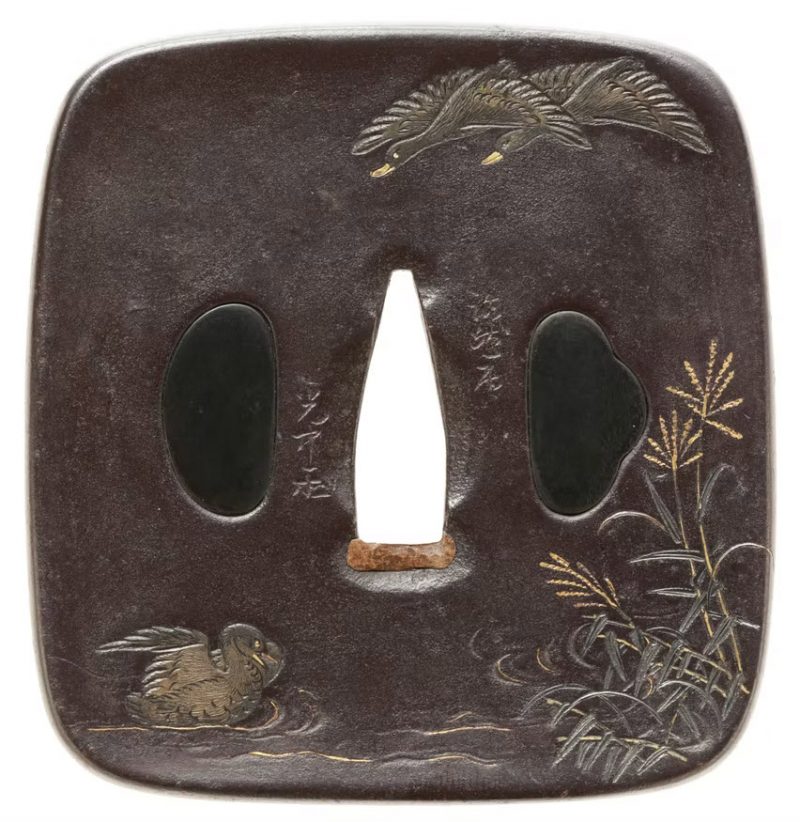
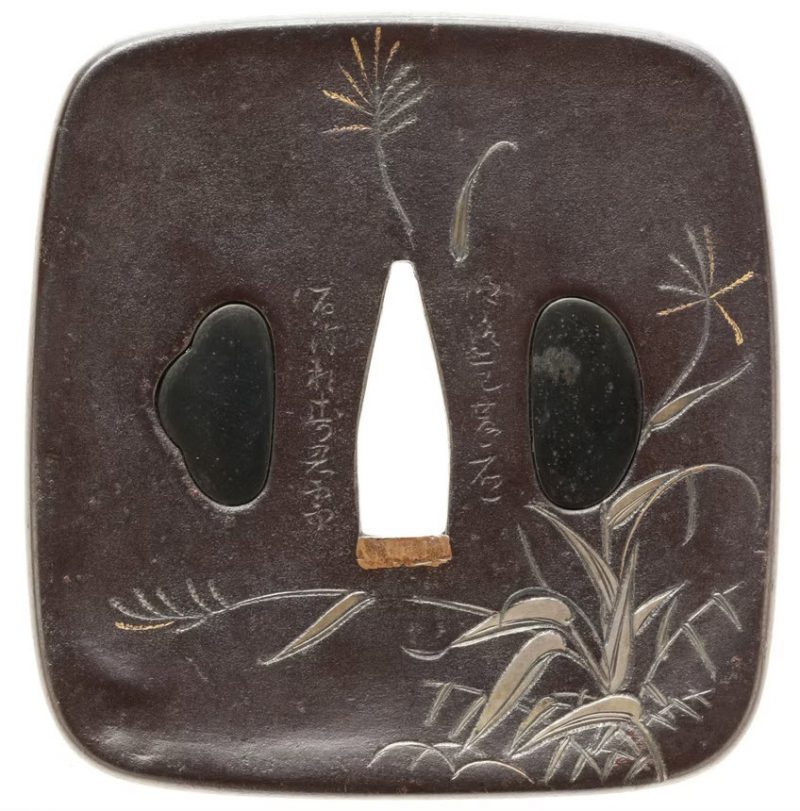
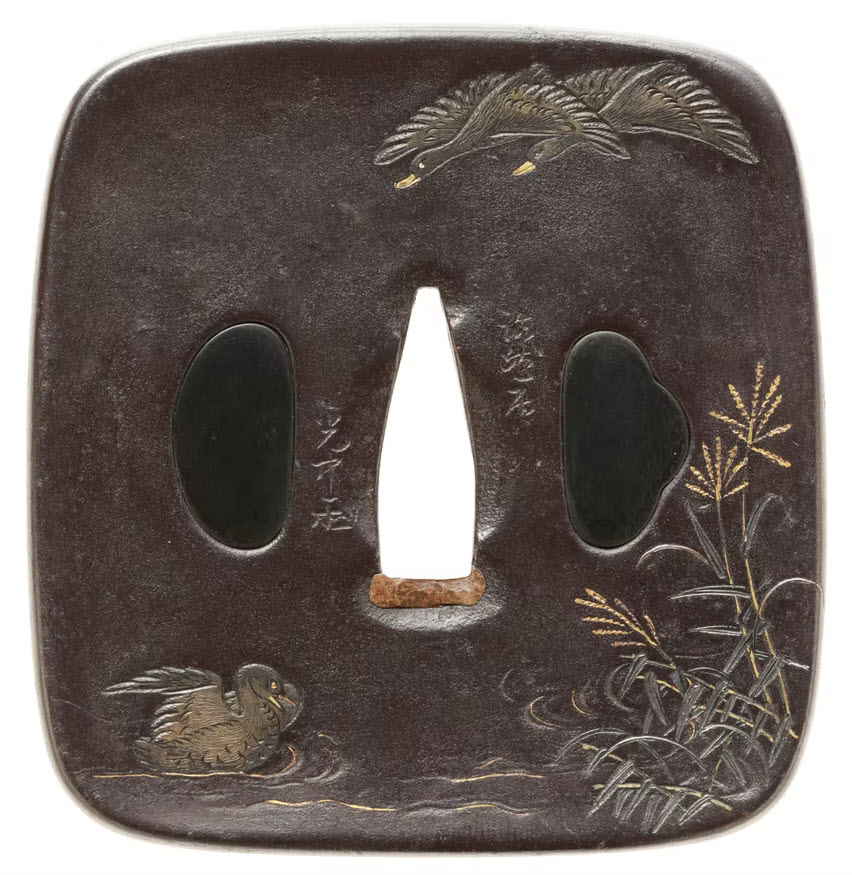
Kyōzan Kōchū, also known as Washida Shinkichi, was a master craftsman renowned for his refined and meticulously executed hira-zōgan (flat inlay), skillfully combining a rich variety of colored metals. In this tsuba, an iron ground is used to evoke the atmosphere of a waterside scene in late autumn. The ground surface, given subtle undulating variation and finished in fine ishime-ji (stone-texture), allows the subject to emerge as though floating within a mist-filled landscape.
The reeds, rendered in flat inlay of gold and oborogin (matte silver) and enhanced with delicate kebori (hairline engraving), appear to sway gently upon the water. The descending geese, alighting toward their chicks, are likewise executed in finely worked kebori and flat inlay, with even the texture of their feathers faithfully conveyed. The reverse is composed solely of reeds, with the ears differentiated through gold and silver flat inlay, a restrained yet deeply evocative treatment.
嚮山光中は鷲田慎吉と称し、多彩な色金を組み合わせた精巧で緻密な平象嵌を得意とした名工。この鐔では、鉄地を用いて晩秋の水辺の風情とし、抑揚変化のある地面を微細な石目地に仕上げて霧の起ち込めた中に主題が浮かび上がるように表現している。金朧銀の平象嵌と繊細な毛彫による芦は水に揺れるように、雛鳥を目掛けて舞い降りる雁もまた繊細な毛彫平象嵌で羽毛までも再現。裏面は芦のみで、穂を金と銀の平象嵌で描き分けているのも味わい深い。

 Loading...

![Tsuba [Furukawa Naohide Hozuki-zu-Daisyo-Tsuba][N.B.T.H.K] Tokubetsu Hozon Tosogu
Hozuki-zu-Dai ...](https://gallery.tsukushi.com/wp-content/uploads/2026/01/176744779348lpc-250x267.jpg)
![Tsuba [Iimura Yoshiaki Shunju-zu-Tsuba][N.B.T.H.K] Hozon Tosogu
Shunju-zu-Tsuba
春秋図鍔 障泥 ...](https://gallery.tsukushi.com/wp-content/uploads/2026/01/17674476444l8pc-250x267.jpg)
![Tsuba [Touryusai-ha Fuujin Raijin-zu][N.B.T.H.K] Hozon Tousougu
Fuujin Raijin-zu Tsuba
鉄地 変 ...](https://gallery.tsukushi.com/wp-content/uploads/2026/01/17674461994lp8c-250x265.jpg)
![Tsuba [Kumagaya-ha Kiku-karakusa-cho-zu-Tsuba][N.B.T.H.K] Hozon Tousougu
Kiku-karakusa-cho-zu-T ...](https://gallery.tsukushi.com/wp-content/uploads/2026/01/176744489648pcl-250x265.jpg)
![Tsuba [Kumagaya-ha Kiku-karakusa-cho-zu-Tsuba][N.B.T.H.K] Hozon Tousougu
Baijyu ni Usagi-zu Tsu ...](https://gallery.tsukushi.com/wp-content/uploads/2026/01/1767444719cpl84-250x250.jpg)
![Tsuba [Umetada Kiku-kiri-zu-Tsuba][N.B.T.H.K] Tokubetsu Hozon Tosogu
Kiku-kiri-zu-Tsuba
菊桐図鍔 ...](https://gallery.tsukushi.com/wp-content/uploads/2026/01/176744318884plc-250x267.jpg)
![Tsuba [Okada Masatomo Kamon-chirashi-karakusa-zu-Tsuba][N.B.T.H.K] Tokubetsu Hozon Tosogu
Lengt ...](https://gallery.tsukushi.com/wp-content/uploads/2026/01/1767442896pc8l4-250x267.jpg)