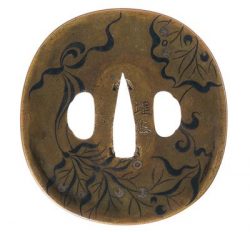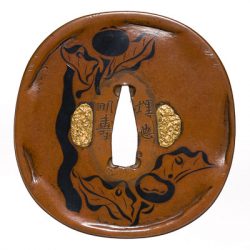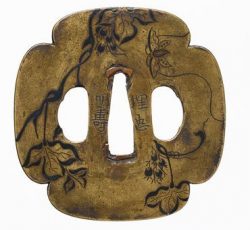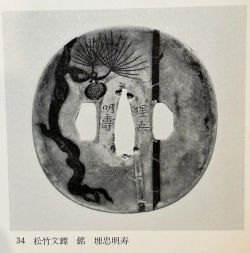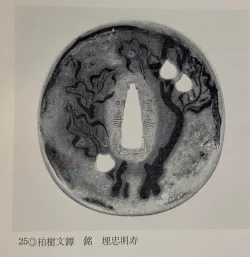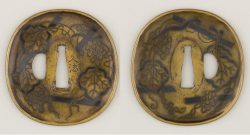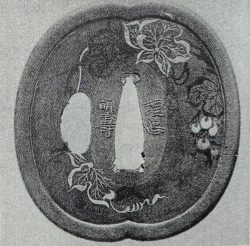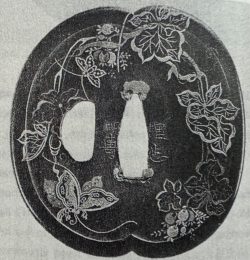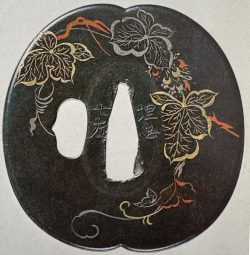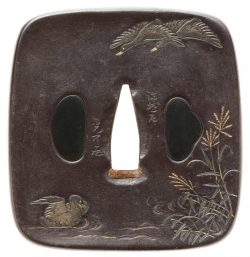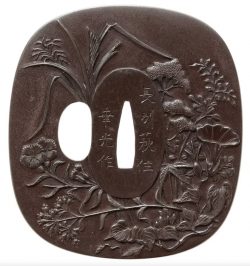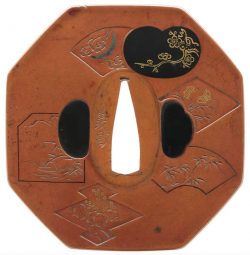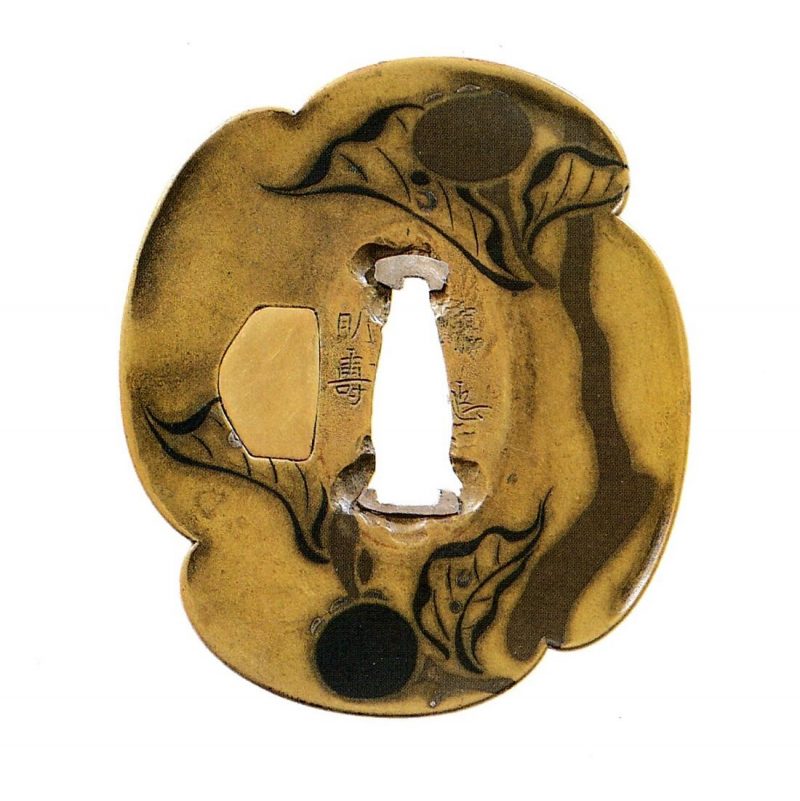
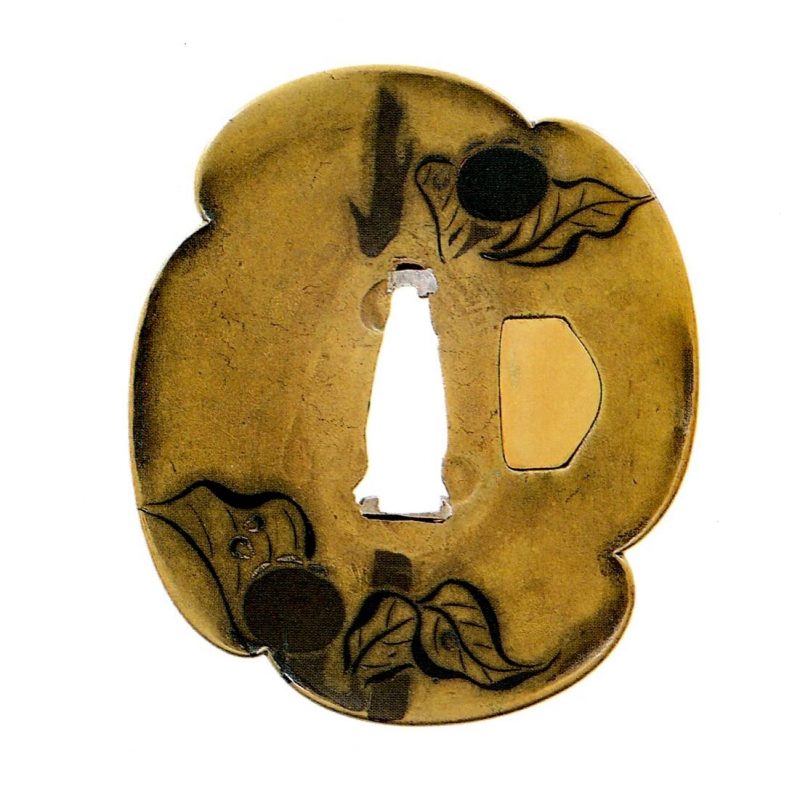
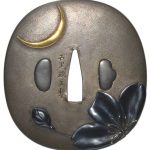
This is a #tsuba by the famous artist Umetada Myōju (埋忠明寿, 1558–1631) ranked Jūyō (Important) by the NBTHK, which had once been a heirloom of the wealthy Maeda (前田) family from Kaga province. It is of a rare kind of “twirled” lobed shape that is not seen with any other works of Myōju, but the #tsuba is otherwise completely rendered in the then so popular Momoyama style. That said, I want you to look at the signature: Its first character on the top right side has been (more or less effectively) punched out some time after the piece was made. To understand, the characters of Myōju’s family name, “Umetada,” mean “to bury (umeru, 埋める) loyalty (chū, 忠)” when interpreted literally. Some #Samurai did not like this meaning, for obvious reasons, especially when giving such a piece as a gift to someone. As a consequence, some later artists of the Umetada School inscribed their family name with the engraving of a “plum” (Japanese: ume, 梅) instead of the homophonous character (埋), like a rebus.

 Loading...
![Tsuba [Furukawa Naohide Hozuki-zu-Daisyo-Tsuba][N.B.T.H.K] Tokubetsu Hozon Tosogu
Hozuki-zu-Dai ...](https://gallery.tsukushi.com/wp-content/uploads/2026/01/176744779348lpc-250x267.jpg)
![Tsuba [Iimura Yoshiaki Shunju-zu-Tsuba][N.B.T.H.K] Hozon Tosogu
Shunju-zu-Tsuba
春秋図鍔 障泥 ...](https://gallery.tsukushi.com/wp-content/uploads/2026/01/17674476444l8pc-250x267.jpg)
![Tsuba [Kumagaya-ha Kiku-karakusa-cho-zu-Tsuba][N.B.T.H.K] Hozon Tousougu
Baijyu ni Usagi-zu Tsu ...](https://gallery.tsukushi.com/wp-content/uploads/2026/01/1767444719cpl84-250x250.jpg)