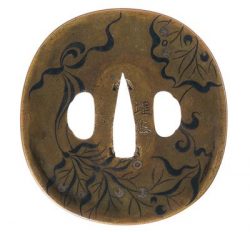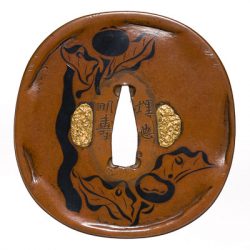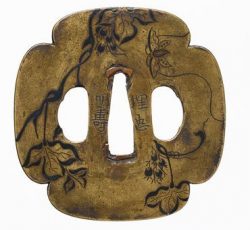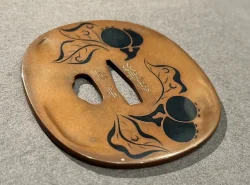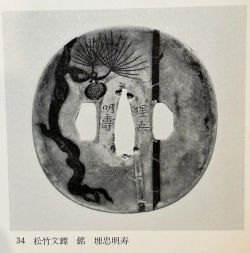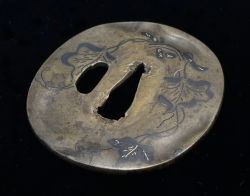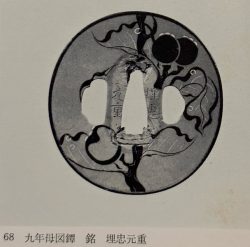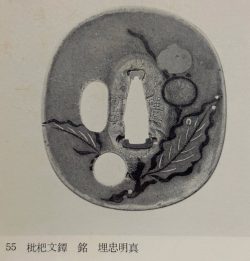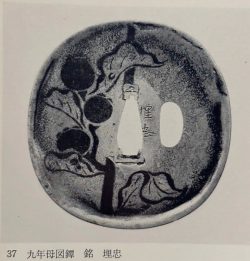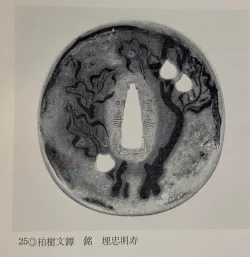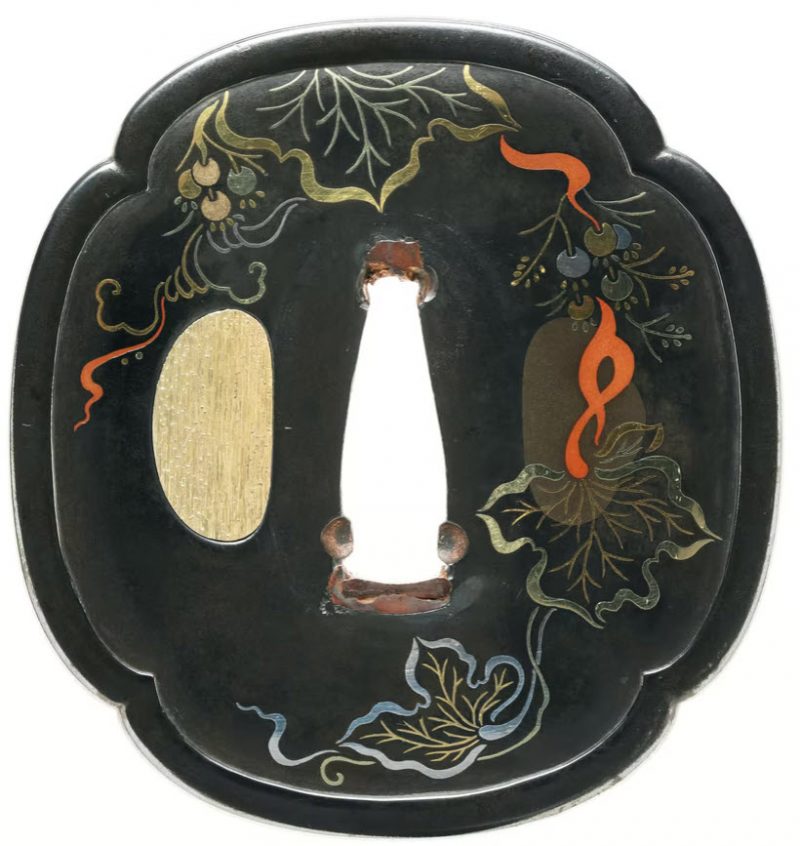
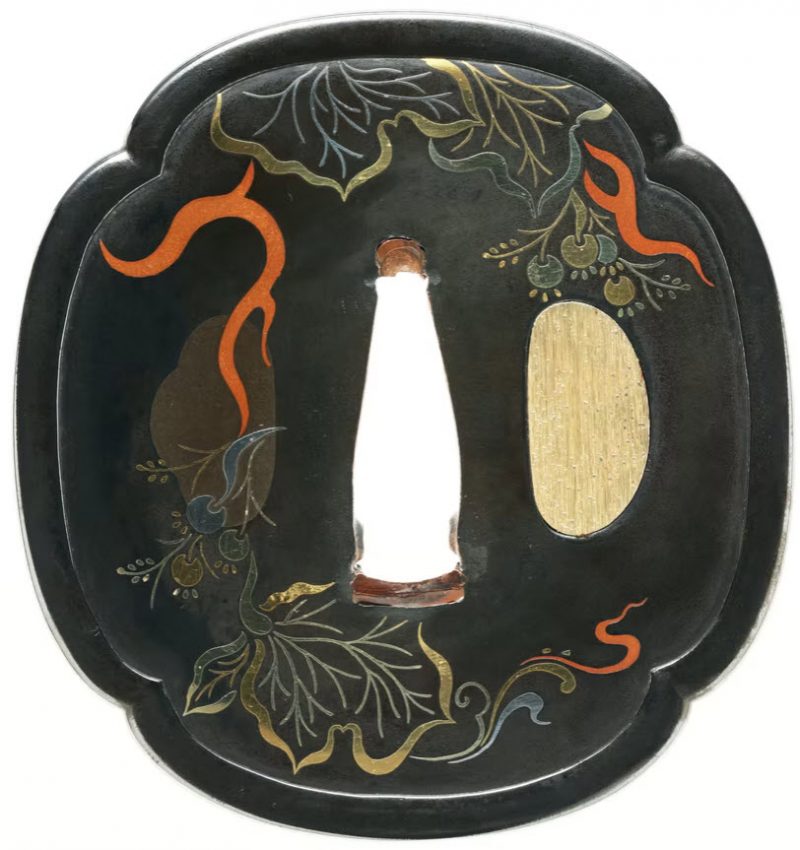
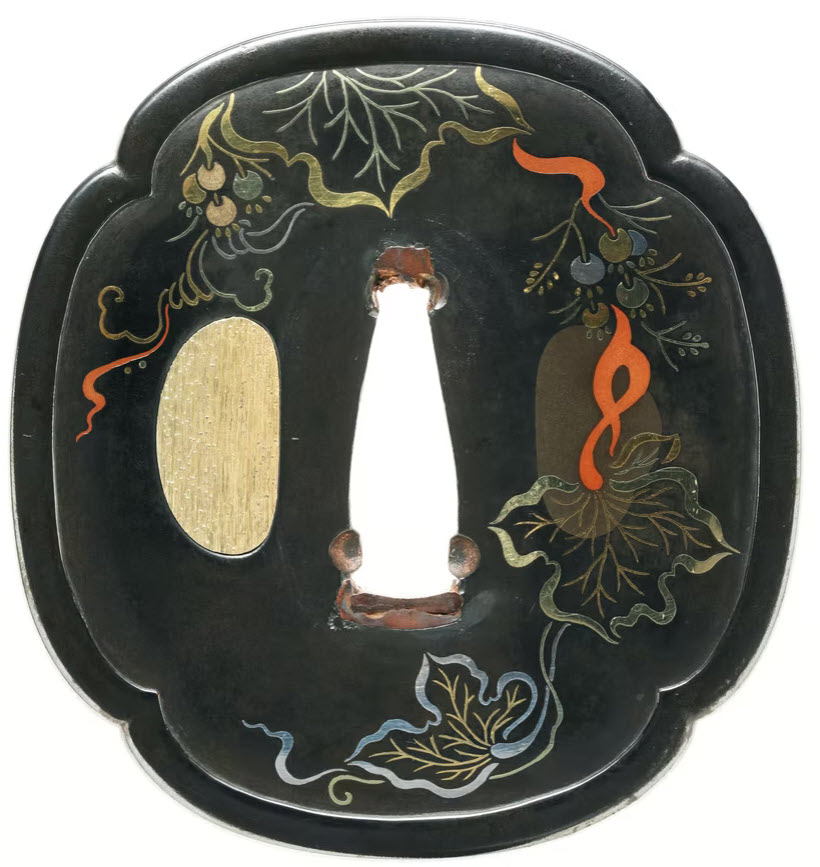
Using lines rich in variation—like brushstrokes made with flowing ink—Umetada Myōju depicted motifs such as grapes and kunenbo (a type of citrus). Though described as line drawing, the metalworking technique employed is his distinctive hira-zōgan (flat inlay).
This refined mode of expression resonates with the aesthetic sensibilities of the Rinpa school and went on to exert a major influence on Kyoto culture of the Momoyama period. This tsuba is likewise a work that conveys Myōju’s technical mastery and artistic sensibility.
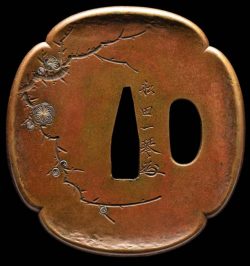
Formed in a mokko shape with a dote-mimi rim, it is crafted from deep jet-black shakudō, with the entire surface finished in finely textured ishime-ji. Across it are rendered expressive flat inlays in gold, silver, copper, and oboro-gin (hazy silver), each differing subtly in tone.
桃山時代 山城国京都
赤銅石目地木瓜形平象嵌土手耳
縦七〇・五㍉ 横六六・八㍉
切羽台厚さ三・五㍉
特製落込桐箱入
特別保存刀装具鑑定書(埋忠)
Momoyama period
Kyoto, Yamashiro province
Shakudo
Height : 70.5mm Width : 66.8mm
Thickness at seppadai : 3.5mm
Kiri box
Tokubetsu hozon (Umetada)
墨筆を走らせたような強弱変化に富んだ線描写で、葡萄や九年母などを描いたのが埋忠明寿。線描とはいえ、金工細工での技術は独特の平象嵌。その洒落た表現は琳派の美意識に通じ、桃山時代の京文化に大いに影響を与えたのであった。この鐔も、明寿の技術と感性を伝えている作。漆黒の赤銅地を土手耳仕立ての木瓜形に造り込み、全面を微細な石目地に仕上げ、色合いを異にする金、銀、素銅、朧(おぼろ)銀(ぎん)の、表情豊かな平象嵌で描き表している。

 Loading...

![Tsuba [Iimura Yoshiaki Shunju-zu-Tsuba][N.B.T.H.K] Hozon Tosogu
Shunju-zu-Tsuba
春秋図鍔 障泥 ...](https://gallery.tsukushi.com/wp-content/uploads/2026/01/17674476444l8pc-250x267.jpg)
![Tsuba [Mumei Shonai Sanchu-zu-Tsuba][N.B.T.H.K] Hozon Tosogu
Sanchu-Zu-Tsuba
三虫図鍔 変り木瓜 ...](https://gallery.tsukushi.com/wp-content/uploads/2026/01/176744691484lcp-250x256.jpg)
![Tsuba [Jingo Ryu-zu Tsuba][N.B.T.H.K] Hozon Tousougu
Ryu-zu Tsuba
葵木瓜形 鉄槌目地 鋤出彫 ...](https://gallery.tsukushi.com/wp-content/uploads/2026/01/1767446390pc4l8-250x276.jpg)
![Tsuba [Edo-Higo Kareki-Chirashi-Zu-Tsuba][N.B.T.H.K] Hozon Tousougu
Kareki-Chirashi-Zu-Tsuba
枯 ...](https://gallery.tsukushi.com/wp-content/uploads/2026/01/176744505548lcp-250x250.jpg)